Why Every Modern Business Needs a Centralized Approval & Workflow System
Introduction
In today’s fast-paced operational environment, many organizations still rely on email threads, printed forms, and manual follow-ups to complete approvals. Whether it’s a material request, purchase order, supplier invoice, HR form, or site service request — the process can easily become slow, confusing, and inconsistent.
A centralized approval and workflow system is no longer a convenience.
It’s now a fundamental requirement for operational efficiency and governance.
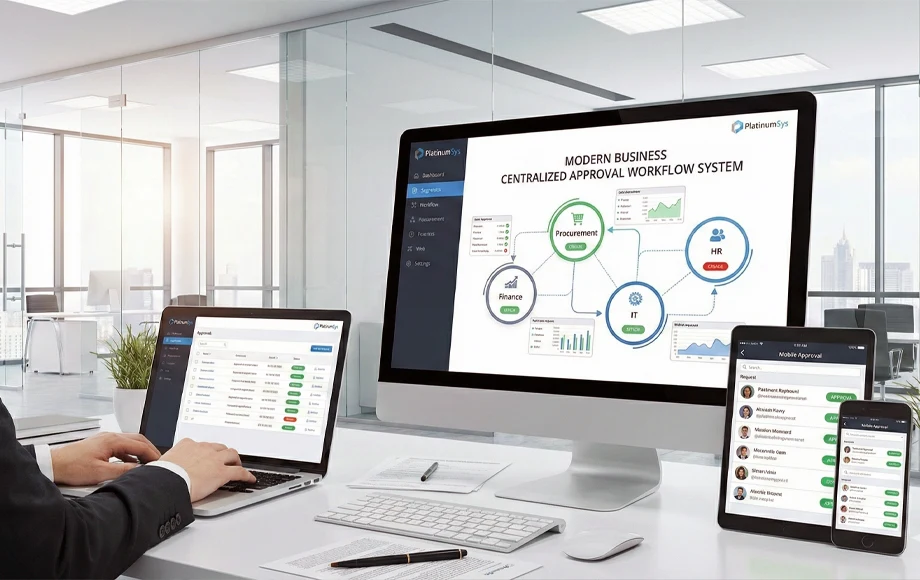
In this article, we explore why companies across construction, contracting, facilities, retail, and project-based industries are now shifting toward digital approval workflows — and how a system like Platinum ERP transforms the entire process.
1. Eliminates Manual Communication & Lost Requests
Email-based approvals often lead to:
- Lost or ignored requests
- Old versions of documents being circulated
- No clear proof of who approved what
- Slow follow-up and poor accountability
A centralized system replaces guesswork with structure. Each request has:
- A unique reference
- A defined workflow
- A clear sequence of actions
- Full traceability of every update
This creates disciplined communication across all departments.
2. Full Visibility Through a Real-Time Progress Timeline
One of the biggest challenges for field teams and office teams is not knowing where the request stands.
A centralized workflow system provides:
- Real-time status updates
- A timeline showing each approval step
- Approver comments and attached files
- Time taken at each level
- A clear indicator of the current stage
This empowers employees, saves time, and reduces internal friction.
3. Ensures Compliance, Accountability & Audit Readiness
Every decision made on a request is recorded automatically:
- Who approved
- Who rejected
- When they acted
- What comments they left
- Which documents were reviewed
This builds a full audit trail, supporting internal audits, client reporting, and legal compliance.
Manual approval systems simply cannot offer this level of reliability.
4. Reduces Duplicate Invoices & Data Entry Errors
Supplier invoice duplication is a serious issue in many organizations.
A centralized workflow ensures:
- Each invoice is submitted once
- All documents are centralized
- Approvers verify data before reaching Finance
- Duplicate or invalid entries are flagged
This protects the company from financial errors and unnecessary payments.
5. Faster Decision-Making & Improved Operational Speed
Automated workflows streamline approval cycles using:
- Instant notifications
- Mobile approvals
- Priority levels
- Reminder alerts
- SLA tracking
This shortens approval time from days or weeks to hours.
Fast approvals translate to:
- Faster purchasing
- Faster payments
- Faster site execution
- Higher productivity
6. Standardized Processes Across Sites & Departments
For multi-site organizations, inconsistency is a major challenge.
A workflow system ensures:
- The same process is followed everywhere
- Standard criteria for approval
- Consistent communication
- Stronger control over project spending
This reduces operational risk and stabilizes company performance.
Conclusion
A centralized approval and workflow system is more than a tool —
it is the backbone of a modern, efficient, and well-governed organization.
Whether your company manages construction projects, services multiple sites, or handles high-volume requests, digital workflows ensure transparency, speed, and control.
Businesses that adopt a structured approval system like Platinum ERP gain:
- Real-time visibility
- Faster approvals
- Better financial control
- Stronger accountability
- A complete digital audit trail
This is the foundation of smarter operations.